When I was planning the trip to London to attend the London Mahotsav, I was searching for a quick-access London food guide writeup of London. But in vain- almost nothing came up. And then came this idea of creating one. I know it’s short; I know it’s not complete- but this is what I could manage to explore within those few days.
London has Big Ben, the Thames, red double-decker buses, and Buckingham Palace. But if you really want to understand London, follow its food. Food has a peculiar way of revealing a city. Landmarks tell you what a city wants the world to see. Food tells you what the city has become. And London, perhaps more than most cities in the world, is a fascinating example of this. It is a city shaped by migration. Walk through its neighbourhoods, and you can travel through continents without ever leaving the Underground. Indian curries sit alongside British classics, Spanish paella competes for attention with Middle Eastern grills, and somewhere in the middle of all this, Bengali food has quietly established its own little corners of London. For someone from Kolkata, that makes London particularly fascinating.
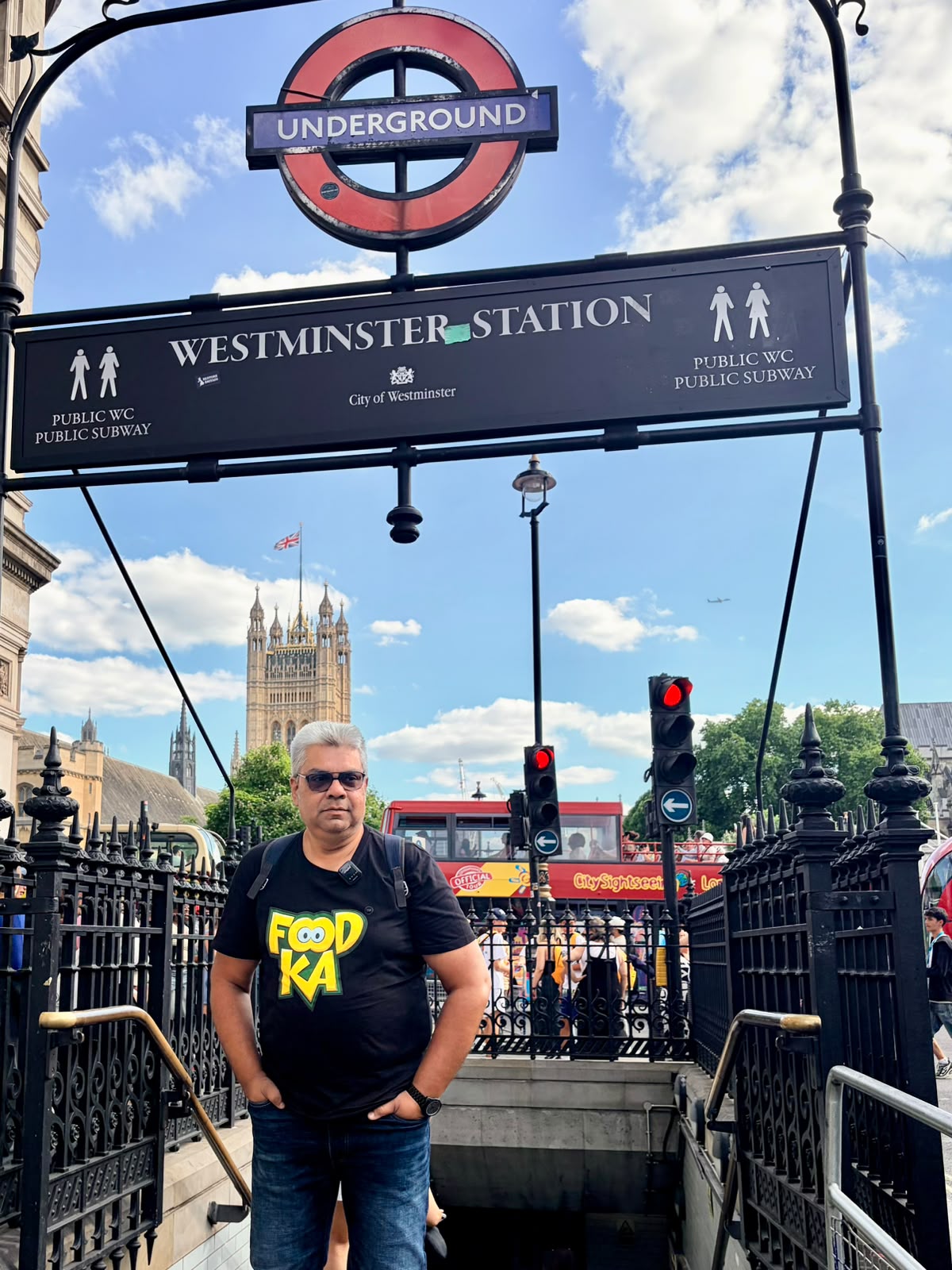
My first impressions of London, like those of many people, came from childhood images—the red buses, the River Thames, Big Ben and, of course, 221B Baker Street.
I even remember playing Scotland Yard as a child. But visiting London for the first time made me realise that the city I had imagined as a child was only one version of London. The real London is far more complex, multicultural and delicious. And on this trip, I decided to explore it not simply as a tourist, but through the language I understand best: food and stories.
From London Mahotsav and the Bengali diaspora to the historic Borough Market, from classic British food at St John Marylebone and Ginger Pig to a plate of unmistakably Kolkata-style biryani at BKC London, this became a journey through food, culture, nostalgia and identity. In many ways, it was a search for a little bit of Kolkata in London.
London and Food: A City Built on Migration
Before beginning our food trail, it is worth understanding why London has such an extraordinary food culture. London’s culinary identity has been shaped over centuries by migration and trade. The British Empire brought ingredients, cooking techniques and food traditions from across the world into Britain, while successive waves of migration transformed the city’s neighbourhoods and restaurants.
Today, London is one of the world’s great multicultural food capitals.
You can eat traditional British food in a historic pub, Spanish food at a market, Indian food in Mayfair, Chinese food in Chinatown and Bengali food in restaurants run by people whose families came from Bengal. For a Bengali traveller, there is an added layer to this story. The Bengali presence in Britain has a long history, particularly through migration from what is now Bangladesh and from West Bengal. Food became one of the most visible ways in which generations of migrants preserved a connection with home.
And that brings us to our first stop.
London Mahotsav: Celebrating Bengali Culture Thousands of Miles from Kolkata
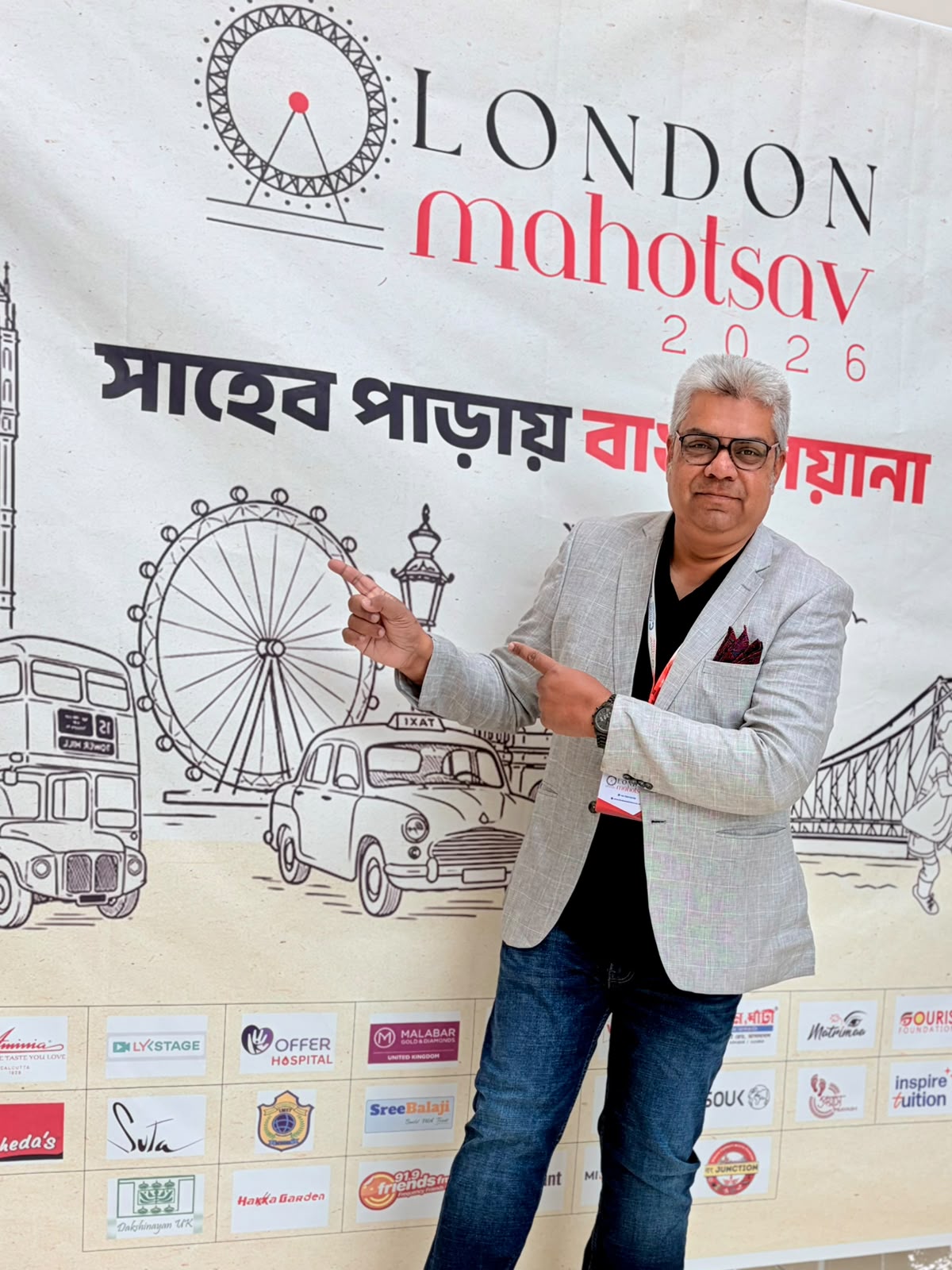
One of our first destinations was London Mahotsav, a major celebration of Bengali culture among the Bengali diaspora in the UK.
Walking into the festival was almost surreal. You are physically in London. But suddenly, Bengali is everywhere. Conversations in Bengali. Familiar cultural references. Food. Music. People discussing Kolkata. For a moment, it felt as though somebody had picked up a little piece of Bengal and placed it in London.
Why London Mahotsav Matters
Diaspora festivals are about much more than entertainment. For communities living away from their country or region of origin, festivals become important spaces for preserving language, food, music, traditions, and collective memory. And food is invariably at the centre of that process. Because food travels exceptionally well. A recipe can travel in a suitcase. A spice blend can travel across continents.
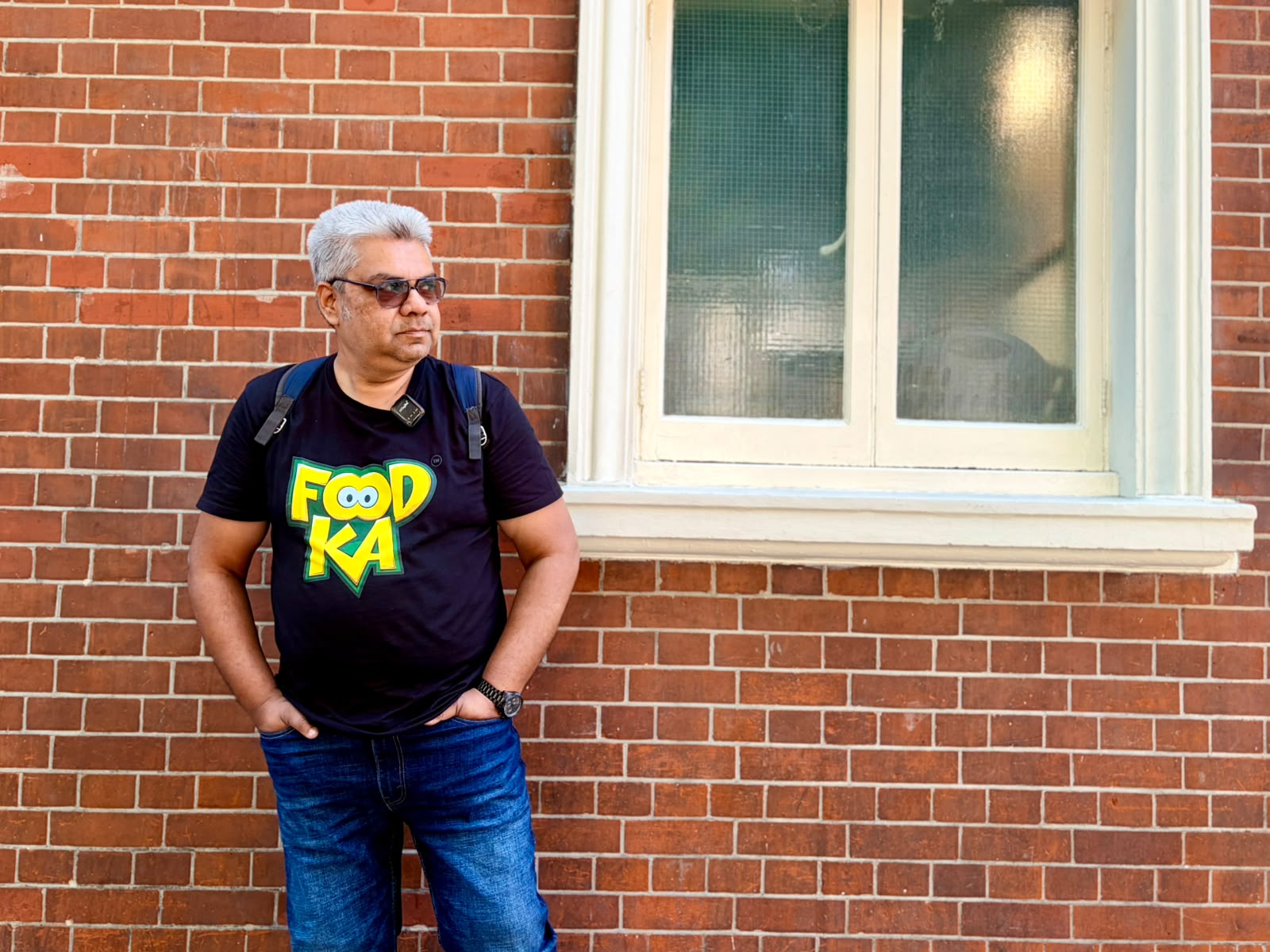
And a taste remembered from childhood can survive thousands of miles and several generations. That was particularly evident during the panel discussion in which I participated as Foodka. The discussion focused on some of the defining pillars of Kolkata’s food culture—from Kolkata biryani and Bengali sweets to the extraordinary history of Kolkata’s Chinese food tradition in Tangra.
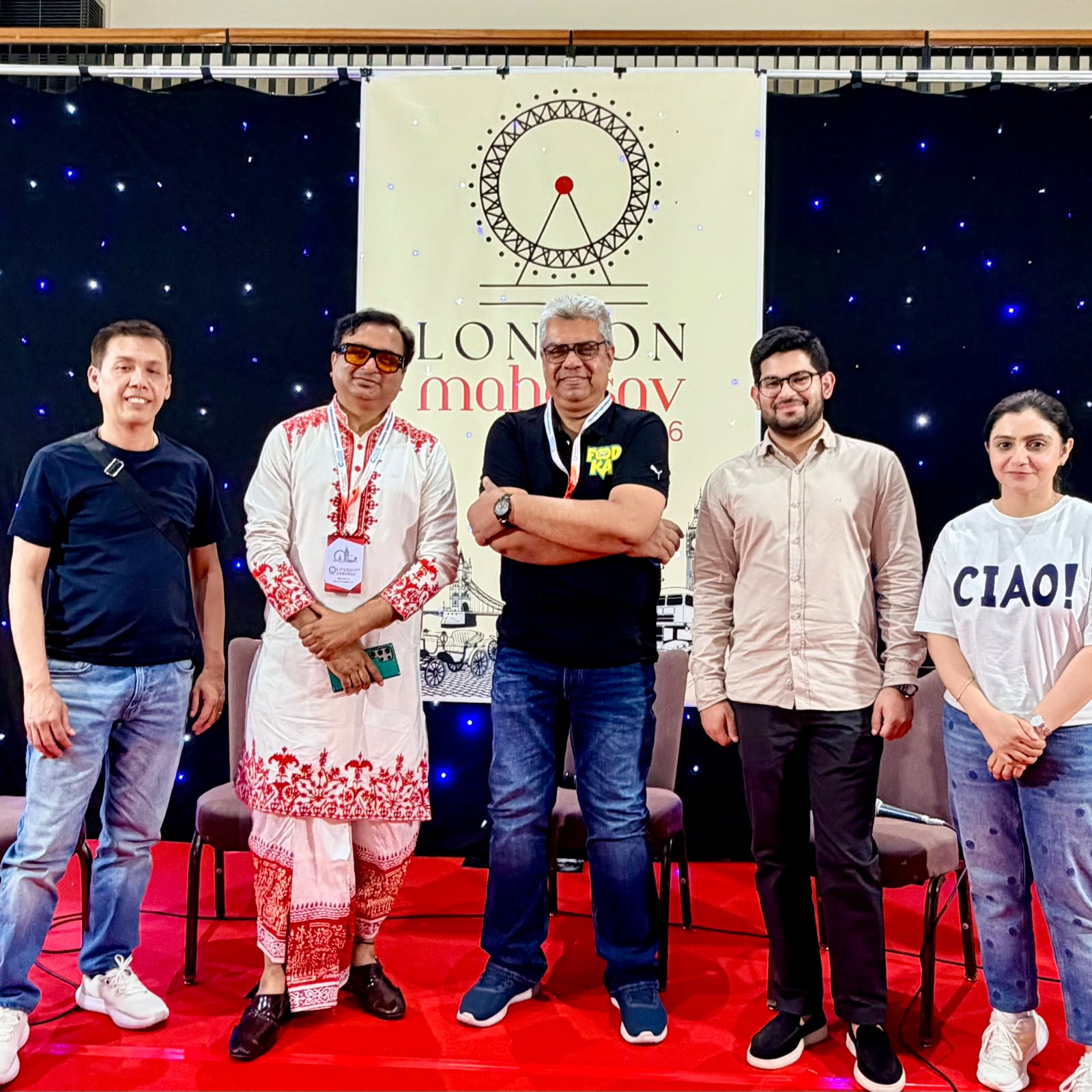
Representatives from Hindusthan Sweets and chef Steven Lee joined the conversation. What struck me most was the audience reaction. Here we were in London, discussing Kolkata’s food heritage—and people were genuinely excited. It was a reminder that Kolkata’s food culture has a reach much greater than Kolkata itself. And perhaps we sometimes fail to appreciate that enough when we are sitting at home.
London food guide: Borough Market: London’s Historic Food Market
After London Mahotsav, the food trail really began. Our next stop was Borough Market. For a Kolkata foodie, the easiest way I can describe Borough Market is this: Imagine Park Street, add centuries of history, and make food the central character.
Of course, Borough Market is very different from Park Street. But that is the feeling it evokes—a place where people come to eat, browse, meet friends, discover ingredients, and simply enjoy the atmosphere.
A Brief History of Borough Market
Borough Market is not a new attraction created for tourists. Its roots go back centuries. Markets have existed around the Borough area for a very long time, with the market evolving over generations alongside London’s growth. Its present identity is strongly associated with the historic market community near London Bridge. That history is part of what makes Borough Market so fascinating. You aren’t simply visiting a collection of food stalls. You are walking through a place where buying and selling food has been part of London’s urban life for generations. And today, Borough Market has evolved into one of the world’s best-known food destinations.
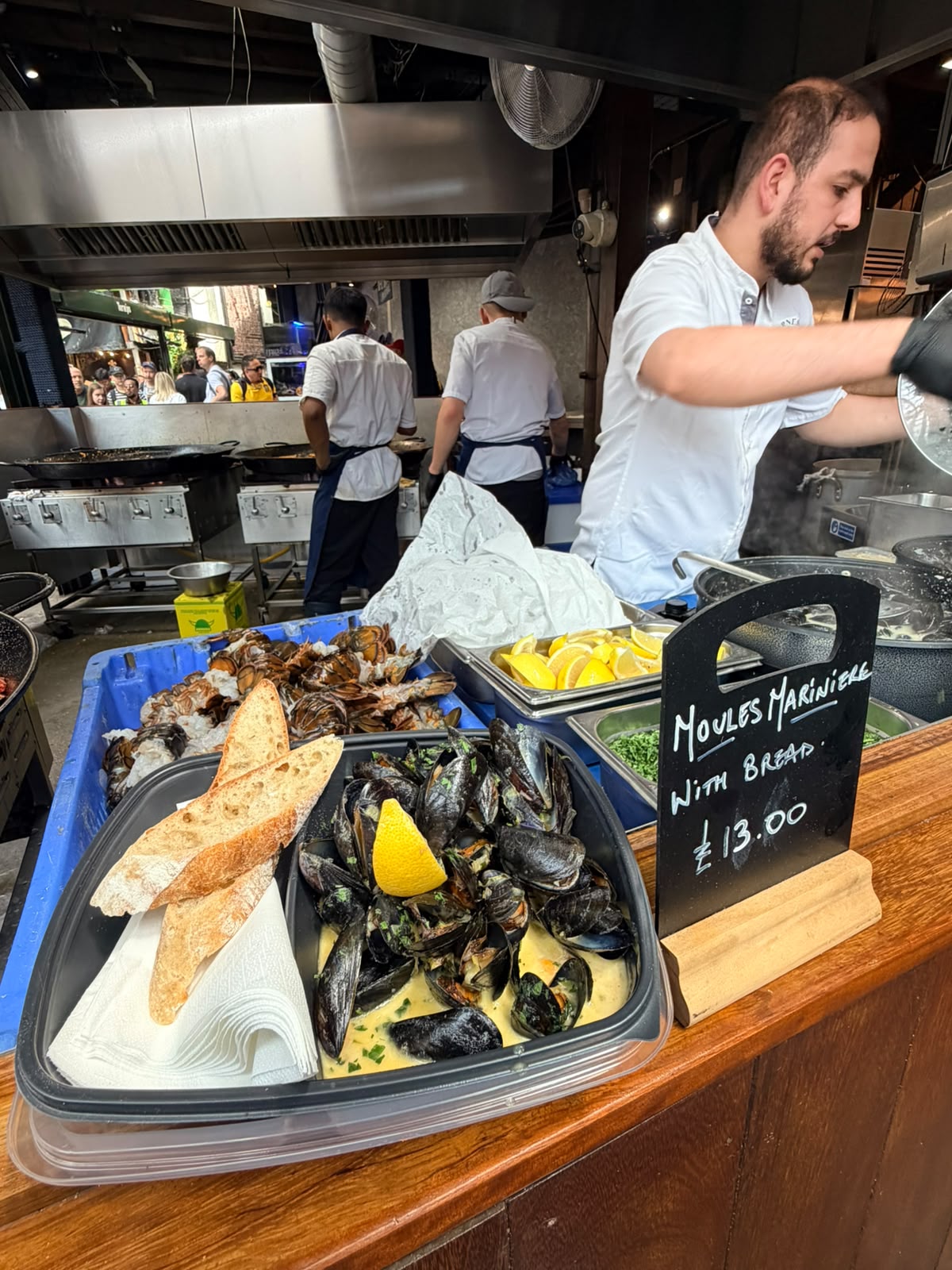
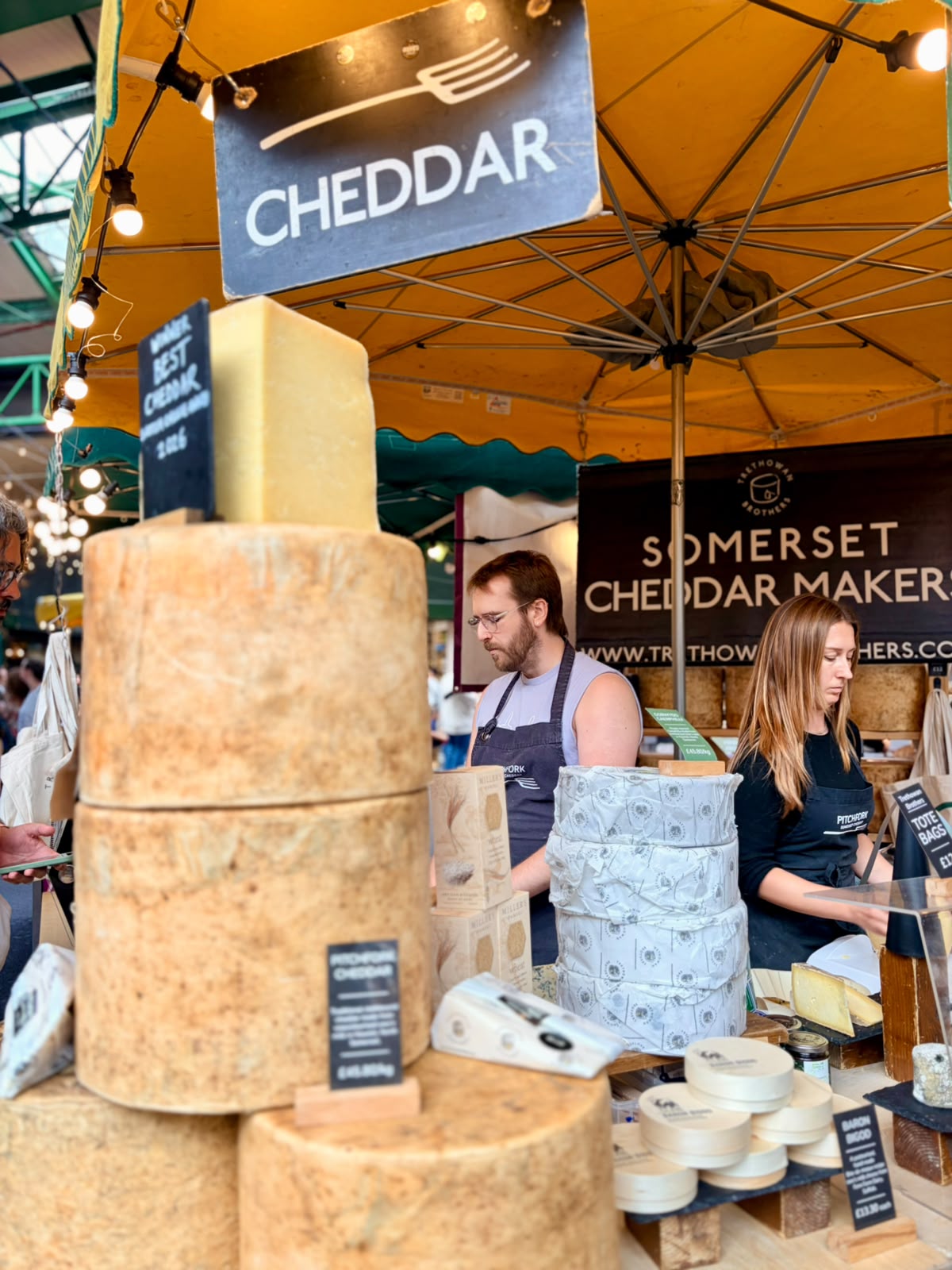
What to Eat at Borough Market
The moment you enter, your senses are attacked—in the nicest possible way.
- Fresh bread.
- Cheese.
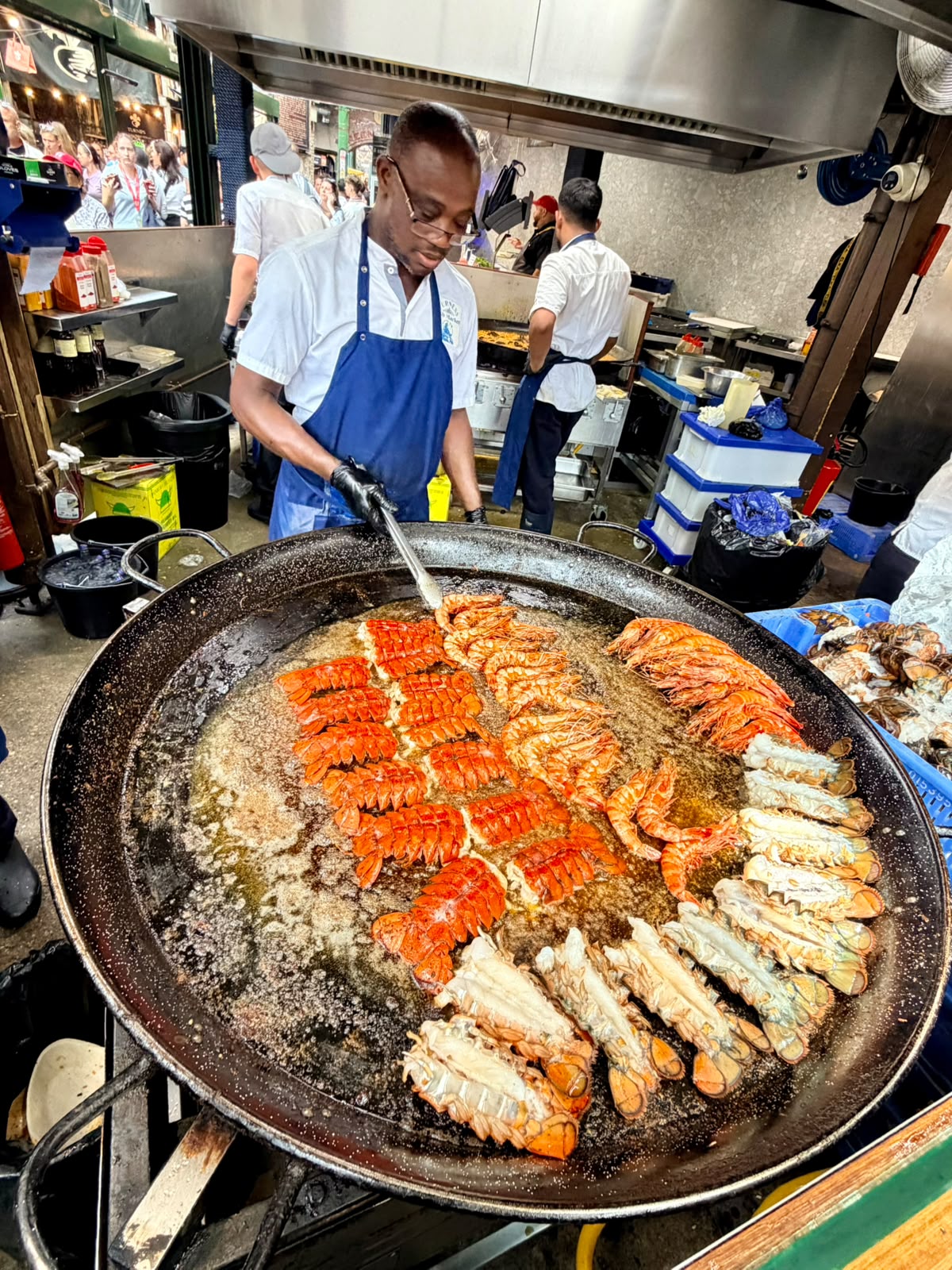
- Seafood.
- Grilled meats.
- Chocolate.
- Desserts.
- Cured meats.
- Fresh produce.
And food representing cuisines from across the world. The freshness of the ingredients is particularly striking. For anyone who loves food, Borough Market is almost dangerous. You walk in thinking you’ll try one thing. Five minutes later you’re carrying three different meals.
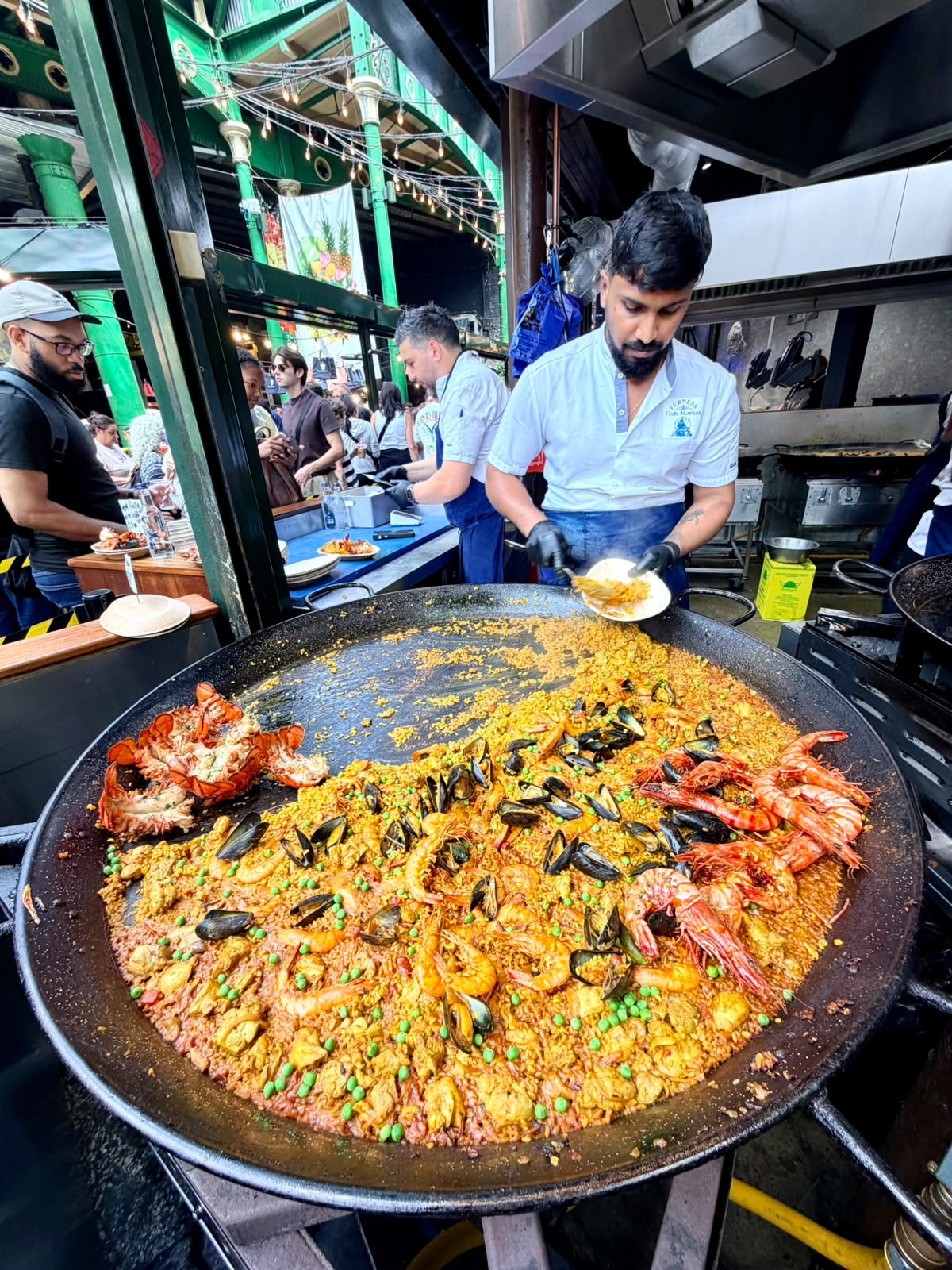
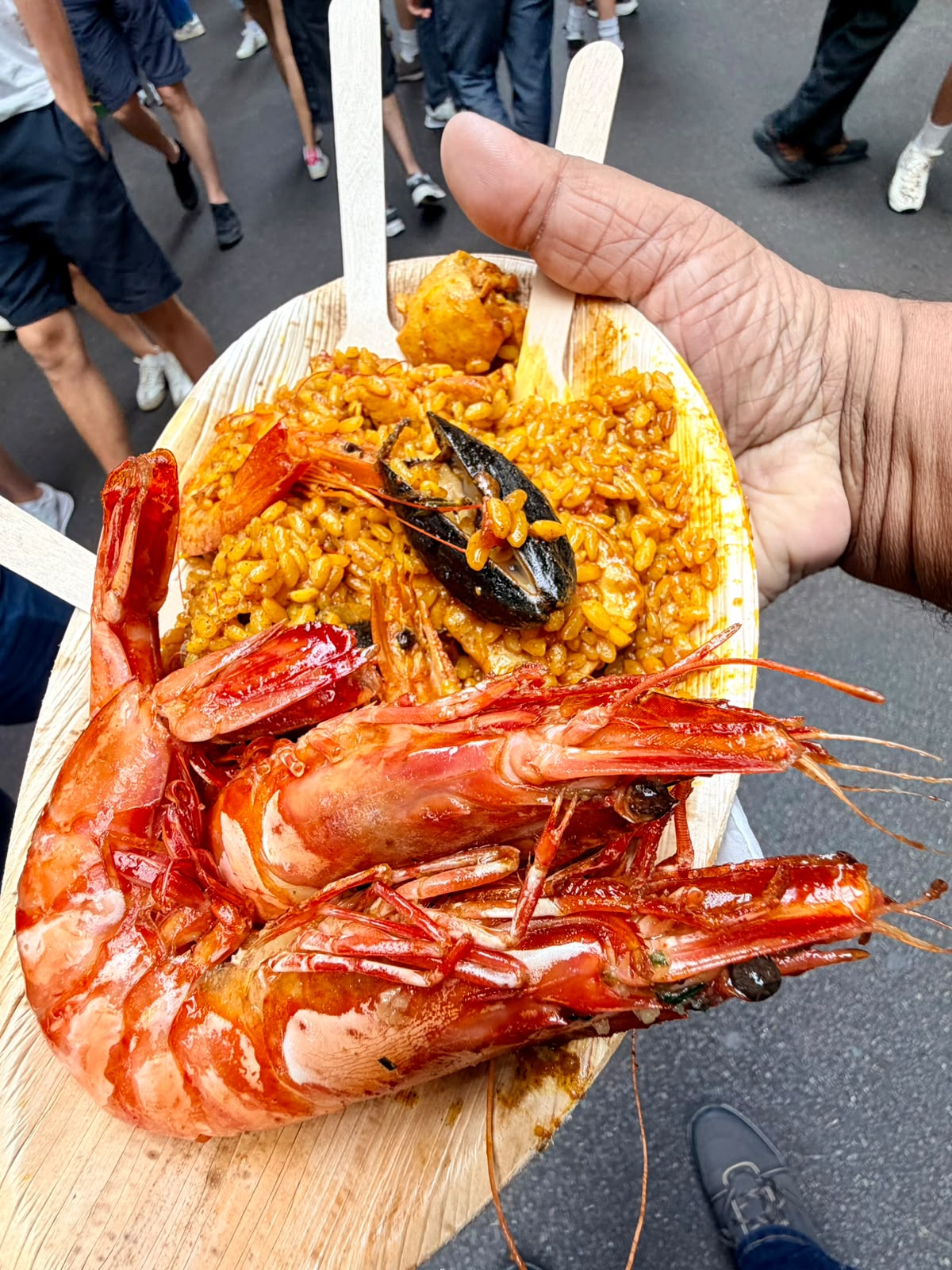
Authentic Spanish Paella
One of the dishes we tried was paella. Fresh seafood, rice, and Spanish seasoning coming together in a large pan is a beautiful example of how relatively straightforward ingredients can create something deeply satisfying. The seafood was fresh, and the flavours were generous without being unnecessarily complicated. And that’s one of the pleasures of eating at a food market. You are not necessarily looking for fine-dining perfection. You are looking for authenticity, energy and ingredients that taste like themselves.
The Famous Duck Sandwich
Then came the duck sandwich. If you are Bengali, duck isn’t exactly an unfamiliar ingredient. In Bengal, duck has its own culinary traditions. Many of us have grown up eating duck curry or hasher jhol. But this was a very different interpretation. Generous quantities of shredded duck tucked into fresh burger buns. And this was not one of those tiny sandwiches designed primarily for Instagram photographs. It was substantial. One sandwich could easily become lunch. That is something I appreciated about many of the food experiences in London—the portions can sometimes be surprisingly serious.
Chocolate, Cheese and a Cold Beer
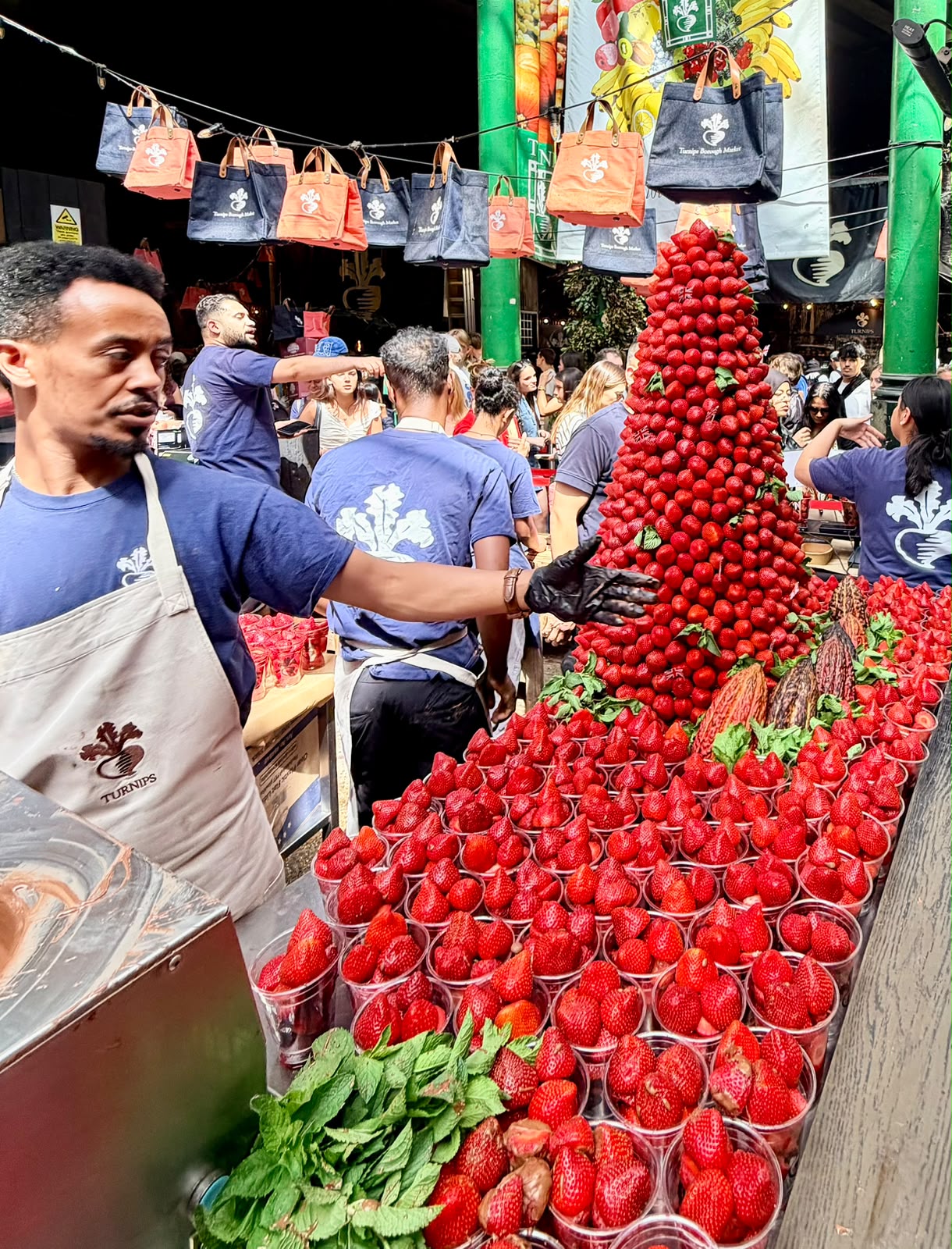
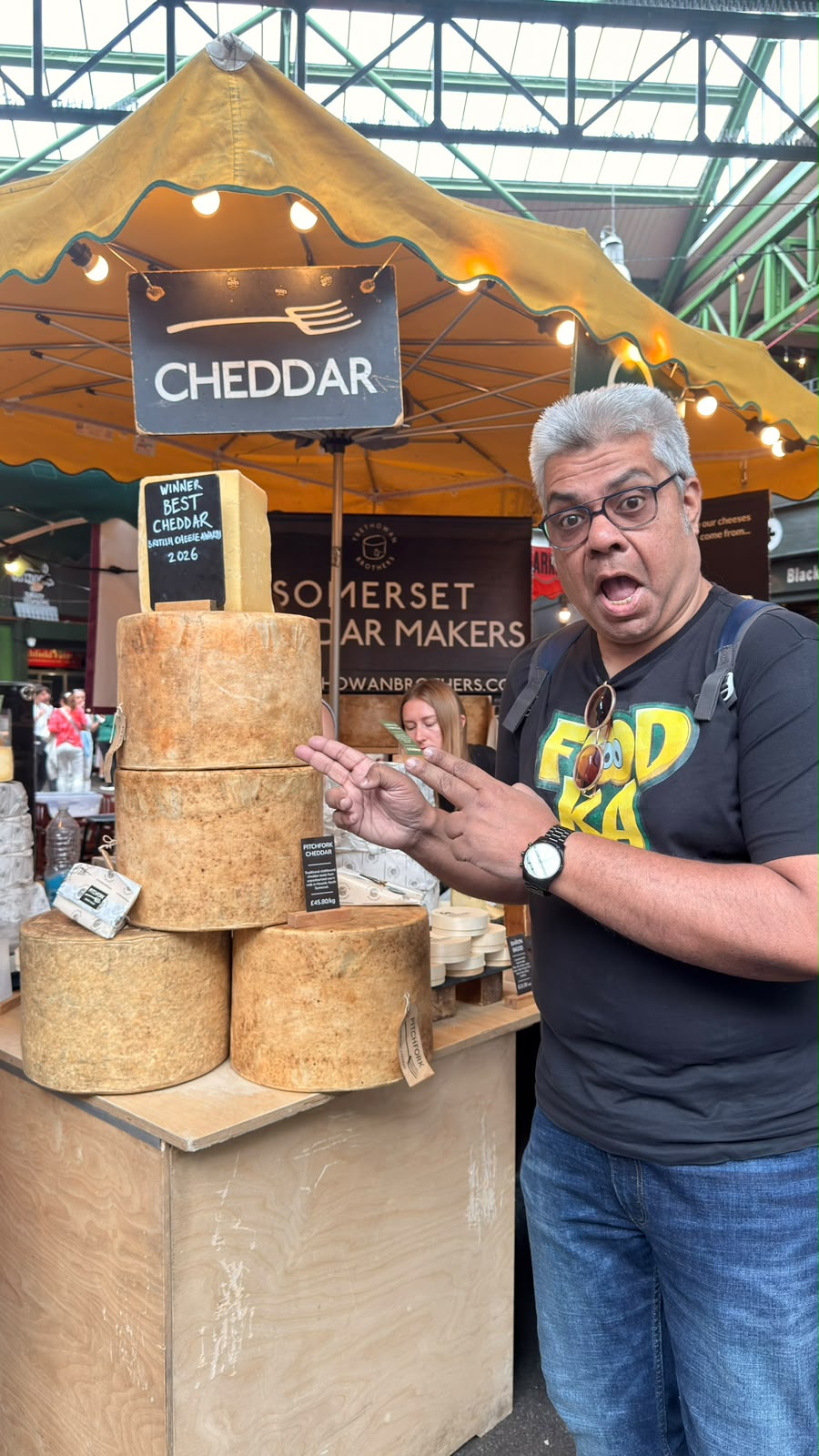
Borough Market is also famous for its specialist cheese shops, artisan bread, handmade chocolates and desserts. We tried chocolate-covered strawberries as well. They looked beautiful. They were being bought enthusiastically by practically everyone around us.
Did I fall completely in love with them?
Let’s just say I have eaten strawberries that have made a stronger impression. But that’s the point of a food market. Not every bite needs to become a revelation. Some things surprise you. Some things disappoint you. Some things make you want another portion. And some simply make you reach for a cold beer. London’s pub culture is an essential part of its social life, and experiencing London without stepping into a pub would almost feel incomplete. Besides, after all that eating, one needs to perform some serious research into the local beverage culture.
Exploring London Like a Local with SmokeAndLime: London food guide
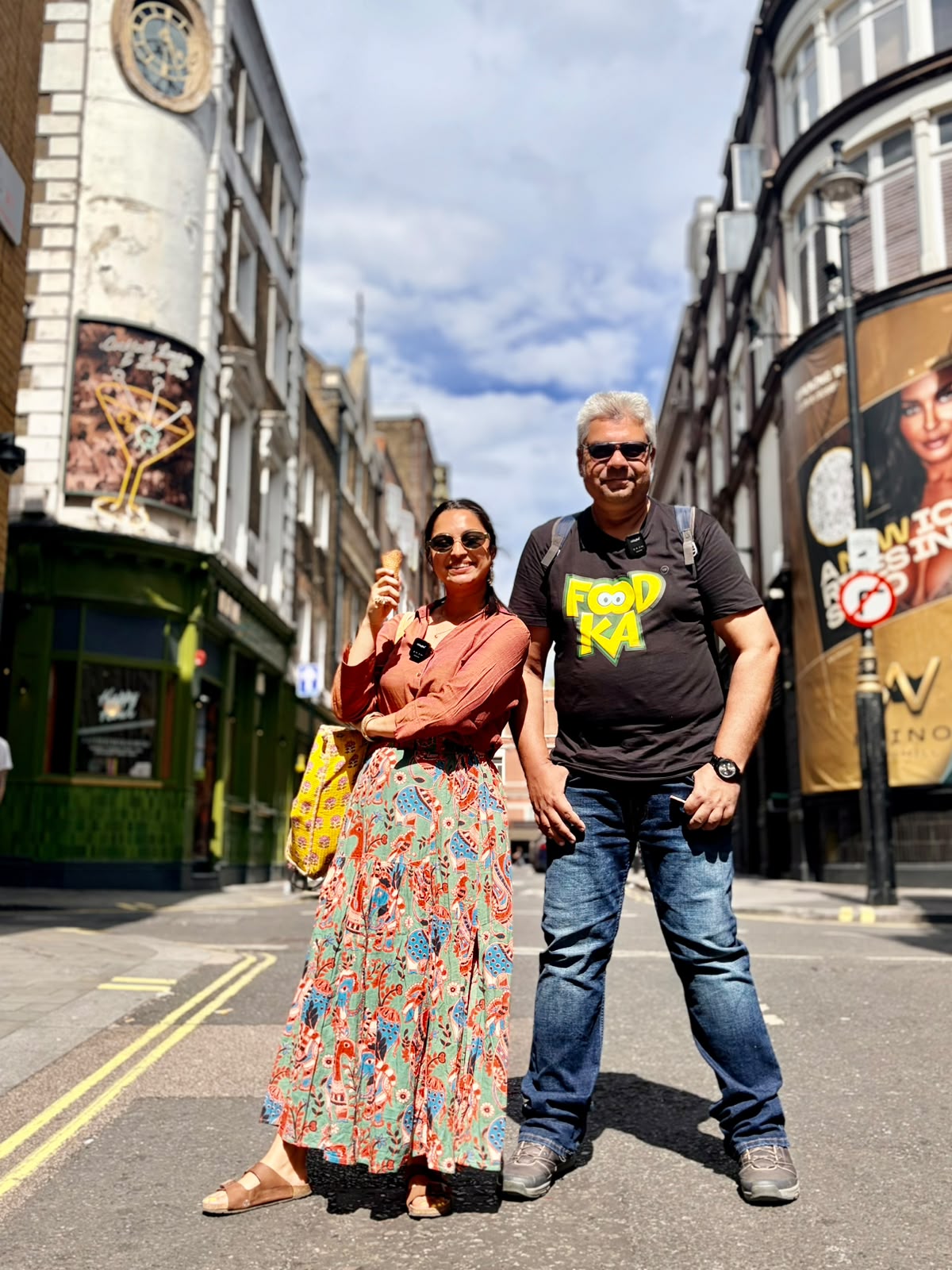
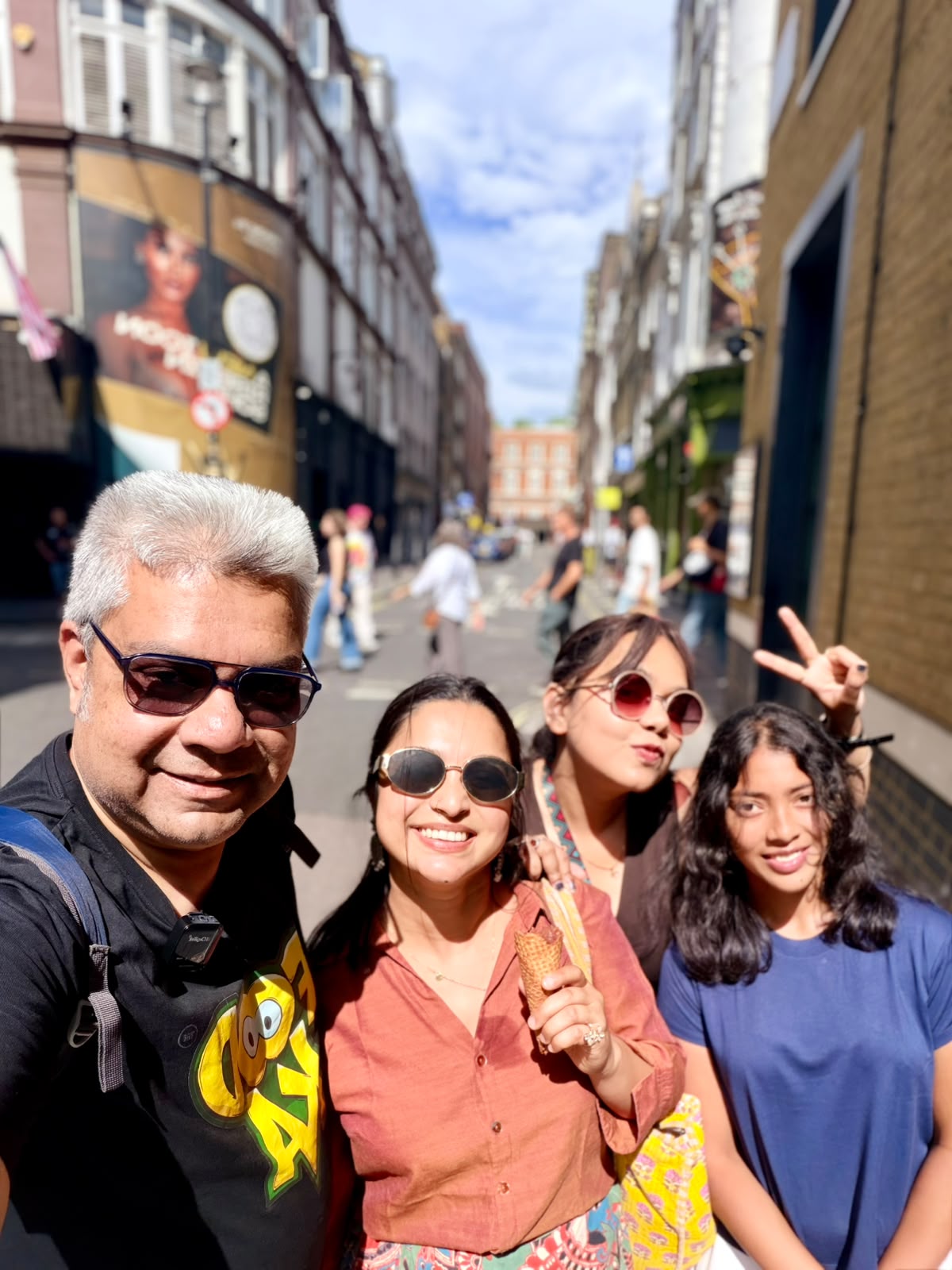
One of the best ways to explore any city is with somebody who knows it beyond the tourist map. For our London food journey, we had the company of popular food creator Sohini of SmokeAndLime. A local food creator can show you a completely different side of a city. Tourists look for landmarks. Locals look for places. And food creators look for the places where those two worlds intersect. With Sohini, we explored some of London’s food spots, including places that offered a more intimate perspective on the city’s culinary culture.
St John Marylebone: British Food and the Art of Simplicity
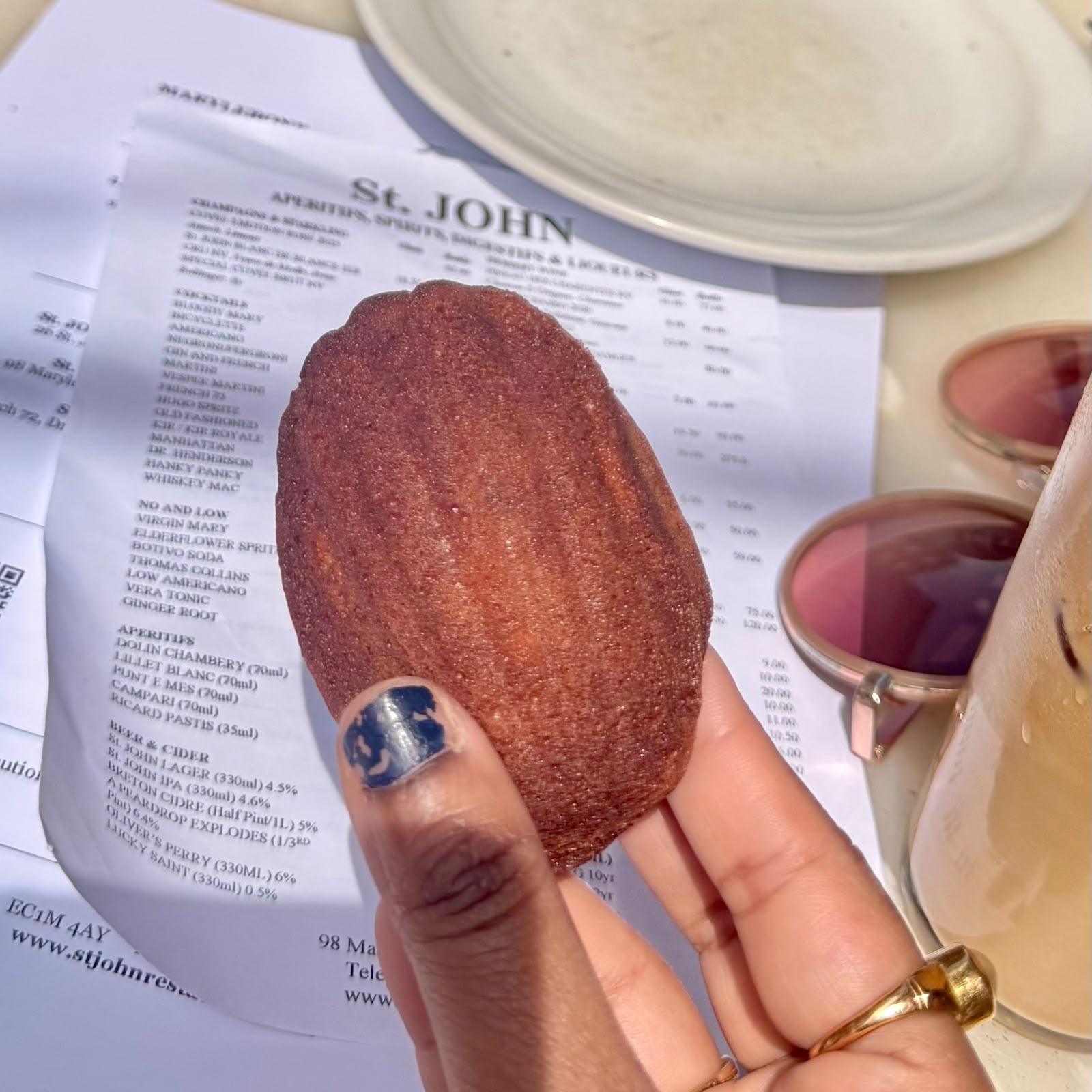
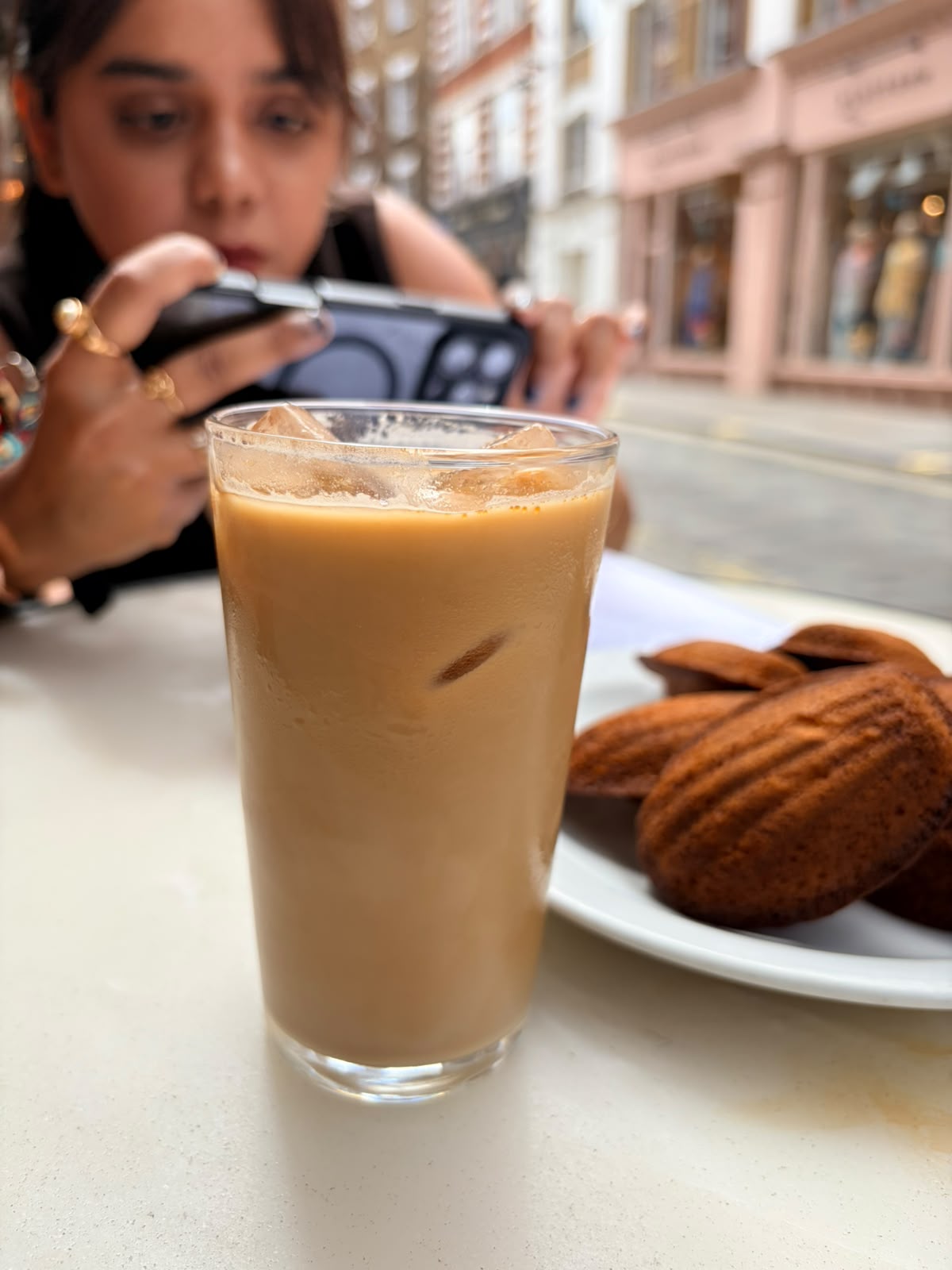
One of our stops was St John Marylebone. St John is an interesting name in London’s food landscape because of its association with the modern British food movement and its famously stripped-back approach to cooking. Instead of elaborate presentation and complicated techniques, the philosophy leans heavily on the ingredient itself. We were there to try the Madeleine, a small French cake that has become one of those deceptively simple pleasures. It is interesting how different this approach can feel to someone from Kolkata. Bengali food often celebrates complexity—spices, tempering, layers of flavour, slow cooking and elaborate preparation. Here, simplicity becomes the point. And perhaps good food doesn’t always need to shout.
Sometimes it whispers.
Ginger Pig: The Sausage Roll That Can Become Lunch
Next came Ginger Pig, a name well known among London meat lovers. One of the things we tried was their famous sausage roll. Now, the sausage roll is one of those quintessential British foods that sounds almost too ordinary. Pastry- Meat. That’s it. But a well-made sausage roll can be remarkably satisfying. The version we tried had crisp, buttery pastry wrapped around a juicy meat filling. The first bite immediately explained the popularity. And let me issue a warning to anyone travelling with a Bengali appetite:
Don’t underestimate a sausage roll.
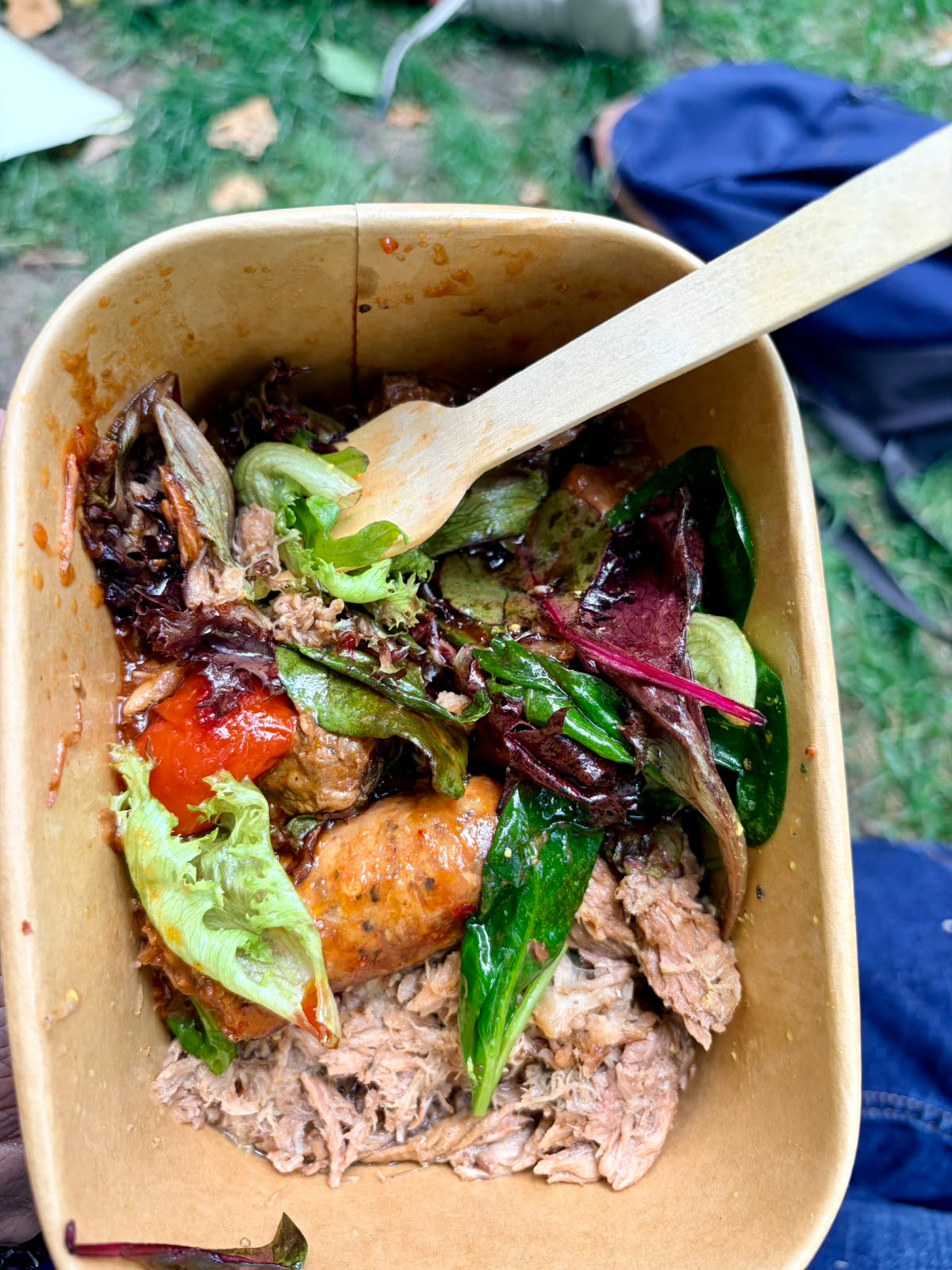
A generous one can easily become lunch. We also tried a meat bowl accompanied by an exceptionally fresh salad. It offered a completely different experience—lighter, fresher and more balanced.

London Beyond the Food: Architecture, Streets and Double-Decker Nostalgia
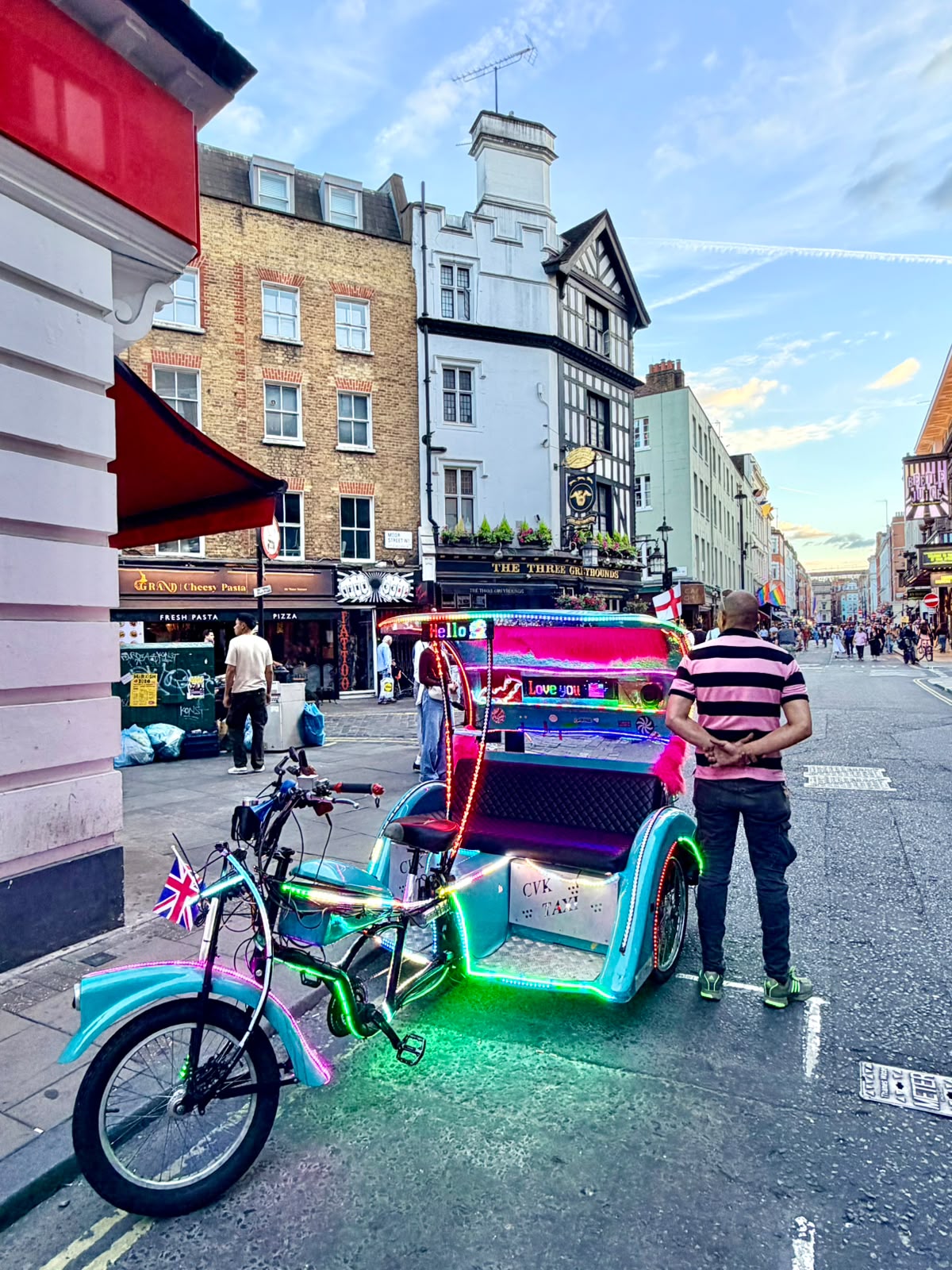
Between meals, London itself becomes the attraction. Historic architecture sits alongside contemporary buildings. Small cafés appear between grand structures. Graffiti occupies walls that have witnessed decades of urban history. People move constantly. The Underground pulls commuters beneath the city while buses and black cabs move through its streets. And then there are the red double-decker buses. For a Bengali from Kolkata, they carry an unexpected emotional connection. Kolkata’s double-decker buses were once an iconic part of the city’s visual landscape. Today, seeing one in London brought back that nostalgia. It was a small reminder that travel doesn’t always mean discovering something entirely new. Sometimes, it means finding something familiar in a completely unfamiliar place.
BKC London: Where Kolkata Biryani Meets London
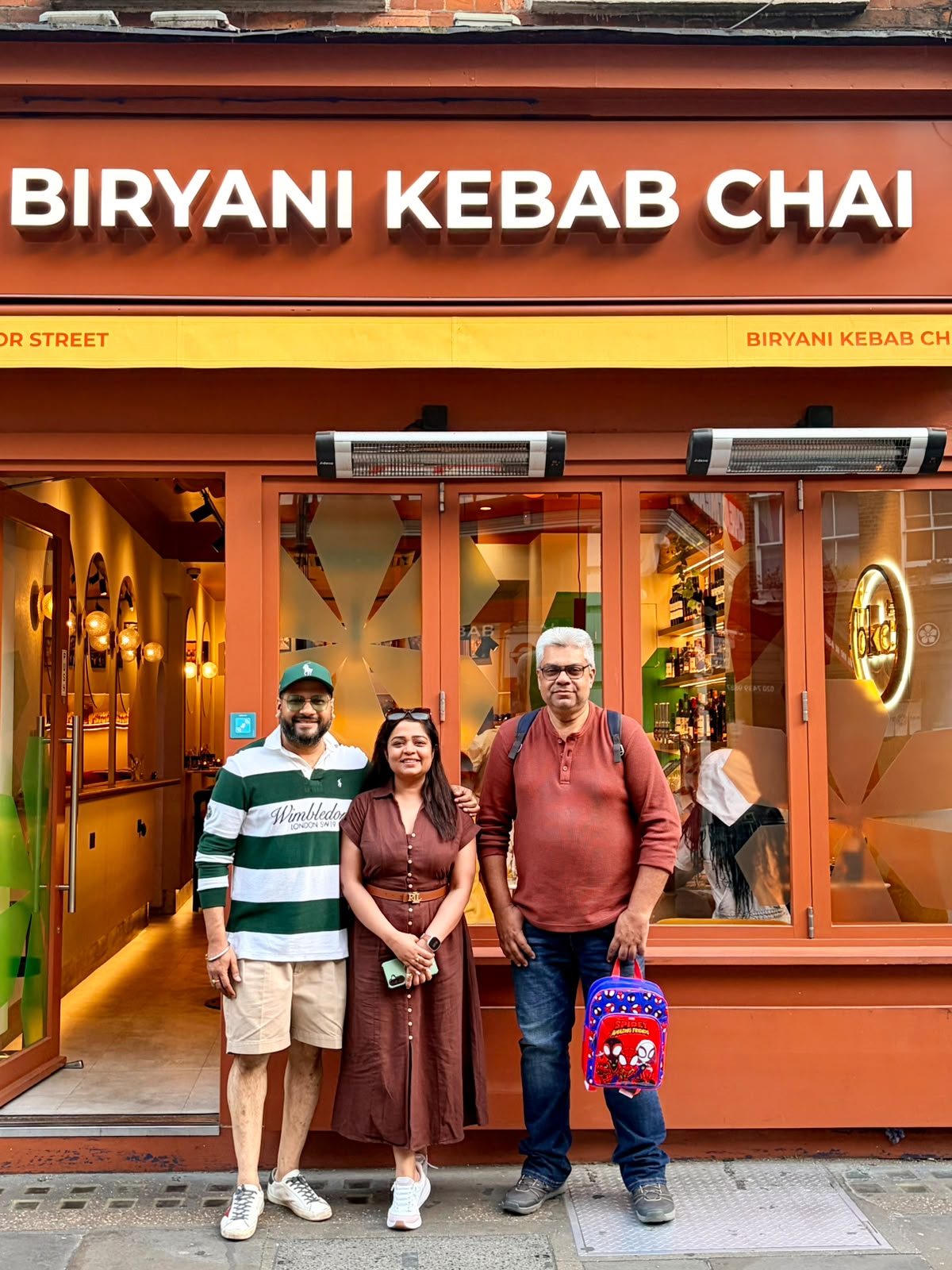
By the end of the day, our final destination was BKC, a popular Indian restaurant in London with a particularly interesting connection to Bengali food and entrepreneurship. And this was perhaps the most emotionally significant stop of the day. Because there is something special about seeing a Bengali entrepreneur create a successful food business in London while carrying elements of home into the experience. For someone from Kolkata, that connection matters. So, naturally, we went in hungry. And the restaurant immediately made an impression. The décor was contemporary and stylish, yet there were clear references to Indian aesthetics. But the real test, as always, was the food.
Kolkata-Style Biryani in London
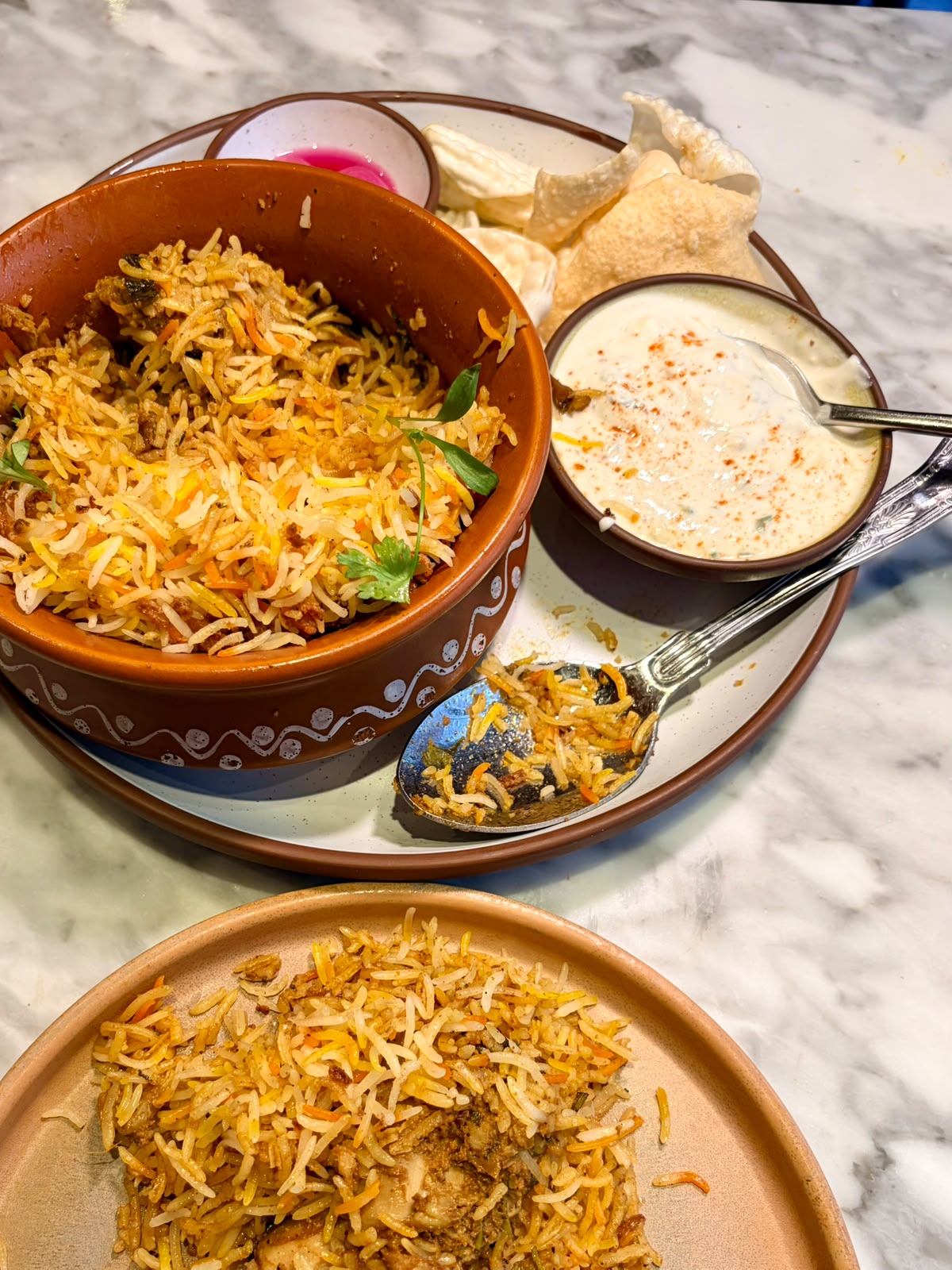
The first thing we tried was the Kolkata-style biryani. And this is where the conversation becomes serious. Because every Bengali has an opinion about biryani. The rice has to be right. The meat has to be tender. The potato has to be present. The spices must be controlled. Too much masala and it becomes something else. Too little and it loses its character. The BKC version had properly cooked rice, tender meat, the familiar Kolkata-style potato, and a restrained level of spice. The first spoonful was immediately recognisable. And that is the magic of food from home. You don’t need to explain it. Your palate remembers.
One interesting detail is that the biryani flavour changes periodically, giving regular diners something new to discover.
BKC London Kebab Platter
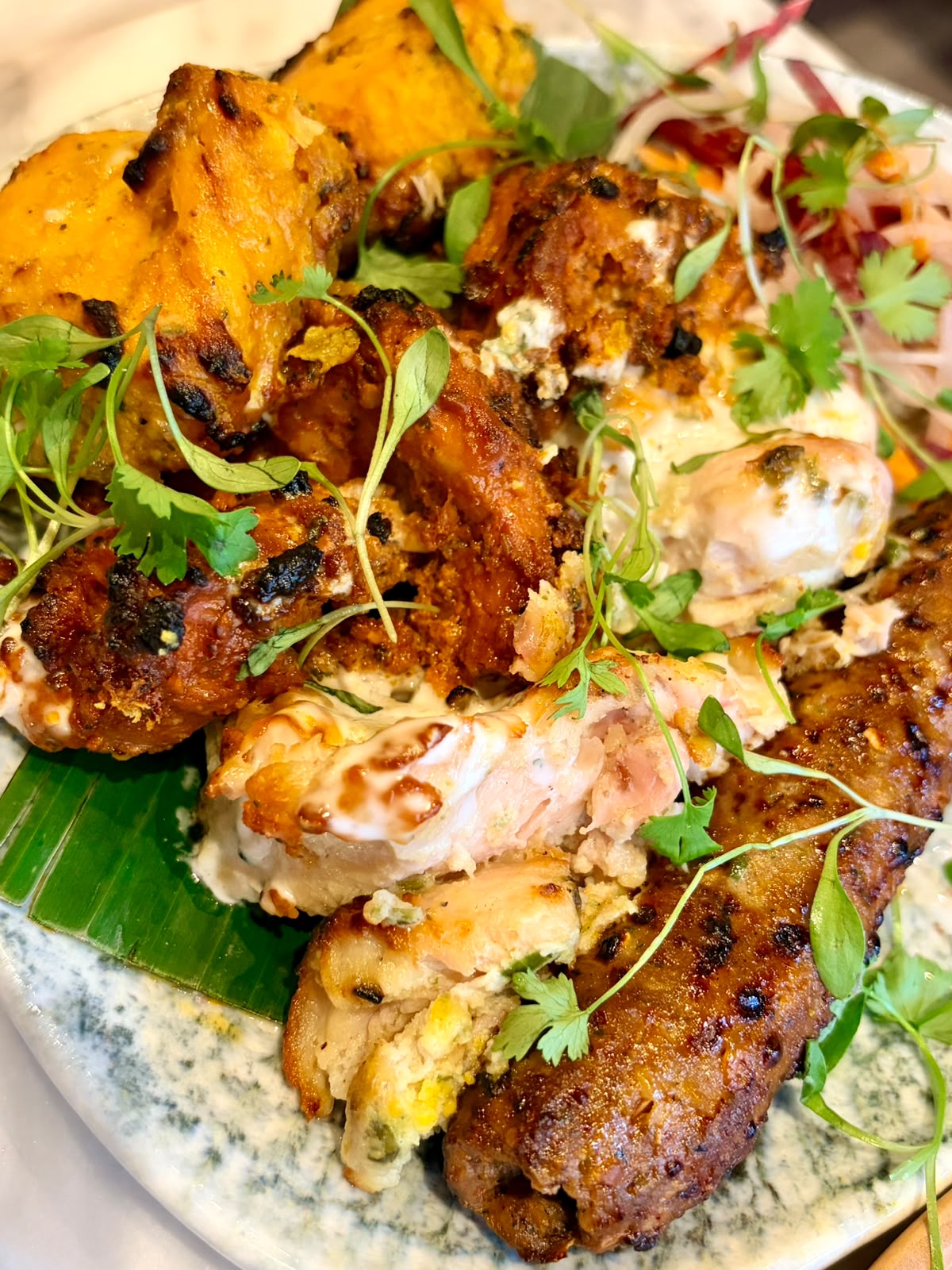
Then came the kebab platter. There were several varieties, including:
- Fish kebab
- Chicken tikka
- Malai tikka
- Mutton seekh kebab
- Prawns
- Mutton galouti kebab
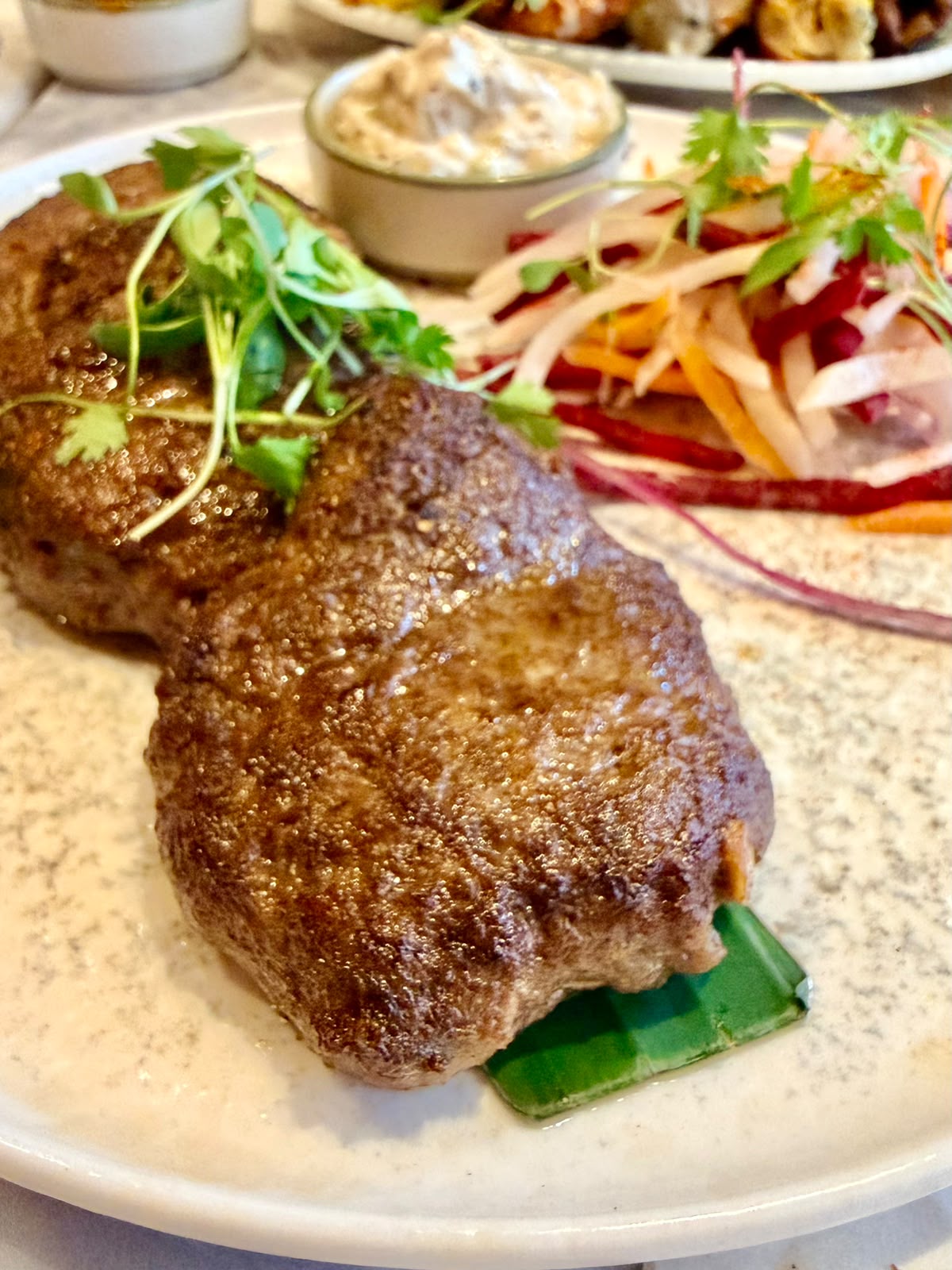
The mutton galouti kebab was particularly memorable. The texture was incredibly soft and buttery, almost melting in the mouth. Galouti kebab itself has an interesting history, traditionally associated with Lucknow and the culinary culture of Awadh. The legend surrounding its creation is connected to the Nawab of Lucknow, who was said to have difficulty chewing meat, leading his chefs to develop exceptionally tender kebabs. Whether one chooses to take every part of that story literally or as culinary folklore, the idea captures something important about Indian cuisine:
Texture matters as much as flavour.
And the galouti at BKC demonstrated precisely that. The smoky, lightly charred kebabs worked beautifully alongside it. There was no bhetki on our platter—which, to be honest, I hadn’t necessarily expected to find in London—but the prawns offered a wonderful alternative.
And Then Came Tea
After a long day of walking, eating, filming and talking, the final course was not an elaborate dessert. It was tea. A steaming cup of hot tea. And somehow, it was exactly right. London is famous for coffee culture, wine bars, cocktails and pubs. But for a Bengali, there is something deeply comforting about ending an exhausting day with a cup of tea. And there was a little irony in the moment too. Here we were in London, and a Bengali was effectively making sure the goras didn’t miss out on the Bengali love affair with tea.
Some traditions travel remarkably well.
Why London’s Food Culture Feels So Familiar to Bengalis
Perhaps the most interesting thing about this London trip was how often the unfamiliar felt familiar. A food market in London could remind us of Kolkata. A double-decker bus could trigger memories of childhood. A Bengali festival could make London feel like home. A plate of biryani could transport us straight back to Kolkata. This is what makes food such a powerful cultural language. When people migrate, they don’t leave everything behind.
They take recipes.
They take memories.
They take techniques.
They take flavours.
And eventually those flavours become part of their new home. That is exactly how cities evolve. London’s food culture isn’t British food sitting separately from Indian, Chinese, Spanish or Bengali food. It is a constantly changing conversation between all of them.
From Kolkata to London: The Journey of a Plate of Biryani
Think about the journey of something as ordinary as a plate of biryani. The dish itself has travelled across continents and centuries. Its history is intertwined with the culinary traditions of the Indian subcontinent, with Persian and Central Asian influences, Mughal cuisine, and regional interpretations. And somewhere along that journey, Kolkata created its own distinctive version. Potato became essential. The spice profile became more restrained. The rice became fragrant and delicate. And eventually, that Kolkata identity travelled with Bengalis around the world. Today, you can find Kolkata-style biryani thousands of miles away from Kolkata. That is not merely a restaurant story.
It is a migration story.
What This London Food Guide Trip Taught Me
Travel often changes your understanding of a place. Before this trip, London was, in my mind, a city of famous landmarks. After spending time there, I realised that the real London exists in its neighbourhoods, markets, restaurants, pubs and communities. It exists in the immigrant who has spent decades building a life there. It exists in the food creator showing a visitor where locals actually eat. It exists in a historic market selling ingredients from across the world. It exists in a Bengali entrepreneur serving Kolkata biryani to diners in London. And it exists in the simple act of people sitting around a table and sharing food. That is why I don’t think this was simply a London food tour. It was a journey through identity, migration, and memory.
A Slice of Kolkata in London
If there is one thing I brought back from London, it wasn’t a souvenir. It was a feeling. The feeling that home can exist in unexpected places. It can exist inside a Bengali festival thousands of miles away. It can exist in the aroma of biryani. It can exist in the sight of a double-decker bus. It can exist in a conversation about Kolkata’s sweets. It can even exist in a cup of tea at the end of an exhausting day. London is often described as a global city.
After this trip, I understood why. It doesn’t simply contain different cultures. It allows them to meet. Sometimes they remain distinct. Sometimes they influence one another. And sometimes they become something entirely new. That is the beauty of food. It crosses borders without needing a passport. And perhaps that is why this London journey will stay with me. I went looking for London. I found London. But somewhere between Borough Market, London Mahotsav, Ginger Pig and BKC, I also found a little bit of Kolkata.
Planning a London Food Trip? Check this London Food Guide
If you’re travelling to London and love food, don’t restrict yourself to the obvious tourist attractions. Explore its markets. Walk through its neighbourhoods. Talk to locals. Try British classics. Explore London’s Indian and Bengali food scene. And, most importantly, leave some room in your itinerary for the unexpected.
Because the best food stories are rarely the ones you plan completely. Sometimes they’re the ones you stumble upon. And if you have already explored London’s food scene, we’d love to know: Which is your favourite London food destination—Borough Market, Ginger Pig, BKC, or somewhere completely different? Because every city has its stories. And sometimes, the best way to hear them is through food.
Bon appetit!!!
indrajit.lahiri@ymail.com

1 comment
I really enjoyed this London food guide, especially the focus on Bengali flavours and the food experiences around Borough Market. It’s fascinating to see how Indian and Bengali cuisine continues to find a place in London while retaining its distinctive flavours and traditions. The mix of local food culture and South Asian influences makes this a great guide for anyone planning a food-focused visit to London. Best cbse school in greater noida